
Perth businesses with 6+ people ask us, WJS Tarining, this question quite often.
According to the Code of Practice: First Aid in the Workplace by WorkSafe Western Australia, it is required that at least one first aid kit be provided at the workplace, and all workers must be able to easily and quickly access a first aid kit. If your team cannot quickly access a first aid kit, you will need more than one.
HR professionals, safety managers, and business owners need to assess how many additional kits are required, because under the legal requirements, this also depends on how the workplace is set up and how many people can easily access it.
To book workplace CPR training or workplace first aid training, click here
How Many First Aid Kits Are Required in the Workplace in WA?
So, the short answer on general guidelines:
- Minimum one kit per workplace. If the first aid kit is not easily accessible to all workers, additional kits are needed.
- Accessibility: Kits must be easily seen and reached by everyone.
- Multi-Level Buildings: At least one kit per floor.
- Mobile Workers: A kit in every vehicle (couriers, etc).
- High-risk/specific industries will need additional kits as well as specific contents of first aid kits.
Below we will dig deeper into the general requirements written in Code of Practice: First Aid in the Workplace by WorkSafe Western Australia; however, if you are still not confident, you can call this institution to get advice – WorkSafe WA.
WorkSafe WA Minimum Requirement
• At least one first aid kit per workplace
• All workers must be able to access it
• Firts Aid Kits must be clearly visible and easy to identify
When More Than One First Aid Kit Is Required
You may need multiple kits if you have:
• Large work areas
• Multiple floors
• Higher-risk zones
• Mobile or vehicle-based workers
Multi-Level Buildings
• At least one kit on every second floor
• Large buildings may need kits at each end
• Floor plans should show kit locations
Mobile Workers
Vehicles used as workplaces must have a first aid kit that is secured safely.
What Must Be Inside a Workplace First Aid Kit
The first aid kit should provide basic equipment for administering first aid for injuries including:
• Cuts, scratches, punctures, grazes and splinters
• Sprains and strains
• Burns
• Amputations and/or major bleeding wounds
• Broken bones
• Eye injuries
• Shock
Contents must match your risk assessment. For example, there may be a higher risk of eye injuries and a need for more eye pads in a workplace in which work involves machinery or chemicals: chemical liquids or powders are handled in open containers, spraying, hosing, or abrasive blasting operations are carried out, welding, cutting, or machining operations are carried out etc.
Extra equipment may be needed in remote workplaces, for example, for serious burns, breathing difficulties or allergic reactions.
High-Risk Workplaces
Extra supplies may be needed where work involves chemicals, machinery, welding, flying particles or infectious materials.
Remote workplaces may need supplies for burns, breathing issues or allergic reactions.
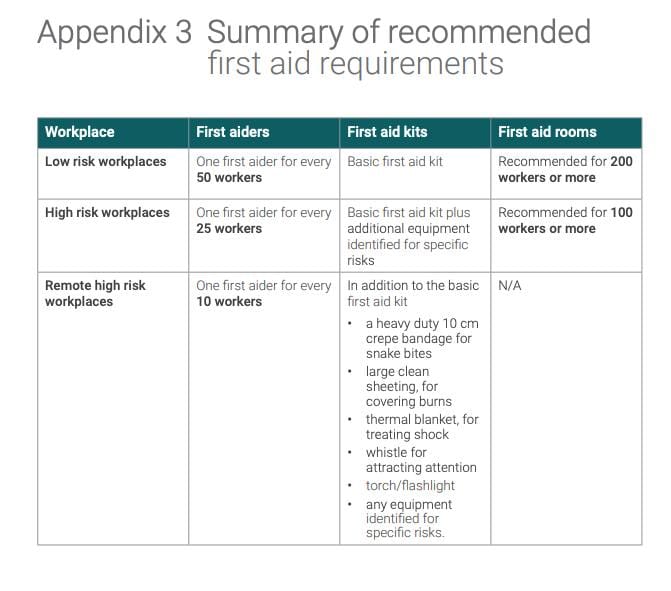
There are recommended first aid kits for remote high-risk workplaces in the table below.
First Aid Kit Design Rules
Each kit should:
• Be large enough to contain the necessary items
• Be immediately identifiable with a white cross on a green background prominently displayed
on the outside
• Include a contents list
• Be made of a material that will protect the contents from dust, moisture, and contamination.
Where Kits Must Be Located
• Prominent and accessible, where they can be retrieved quickly. All workers must have access to first aid equipment, including in security-controlled workplaces
• Close to higher-risk areas. For example, a school with a science laboratory or carpentry workshop should have first aid kits located in these areas.
• A portable first aid kit should be provided in the vehicles of mobile workers if that is their
workplace, for example, couriers, taxi drivers, sales representatives, bus drivers, and inspectors. These kits should be safely located so as not to become a projectile in a collision.
Maintaining First Aid Kits
A nominated person should:
• Replace used items
• Check kits after use or at least every 12 months
• Sign and date inventory lists
• Check expiry dates, that items are in working order, and sterile products are sealed and have not been tampered with.
WJS Training – First Aid and CPR Training at Your Workplace
We support Perth businesses with groups of 6+ people.
Training is practical, completed in around 2 hours, usually, with same-day certification.
Book Group Training: https://app.acuityscheduling.com/schedule/4a027a85?ref=embedded_csp
FAQ
Q: How many first aid kits are required in the workplace?
A: At least one — and more where staff can’t access it quickly.
Q: Do vehicles count as workplaces?
A: Yes. Work vehicles must have a first aid kit that’s secured.
Q: What if my workplace has different risk zones?
A: Each zone should have its own kit so help is very accessible when it’s needed most.